Foundation Watering
in Haltom City —
Every Vintage of Home.
Haltom City is about fifteen minutes from my North Richland Hills base, and it has the widest mix of homes anywhere in my service area — 1950s houses that never had irrigation right beside new builds. They all sit on the same shrink-swell clay, and a dedicated foundation drip zone keeps that clay steady whatever the vintage of the home. It runs any day, separate from your sprinkler limit. $0 service call. Free on-site assessment. And if your house doesn't need one, I'll tell you.
Foundation watering in Haltom City means installing a dedicated drip zone that keeps the expansive North Texas clay around your slab evenly moist, reducing the shrink-swell movement that cracks foundations. It's done by licensed Texas irrigator Landon Melvin (TCEQ LI0031476), based in nearby North Richland Hills, about 15 minutes away. Foundation drip is exempt from the twice-a-week sprinkler limit, so it can run any day. $0 service call, free assessment, and an honest answer on whether you need one.
It's the Clay Under Your House.
Haltom City sits on the same expansive clay as the rest of the Mid-Cities — soil that swells when wet and contracts hard when dry. Across a housing stock that spans seventy years, that one constant is what moves foundations here.
The clay shrinks
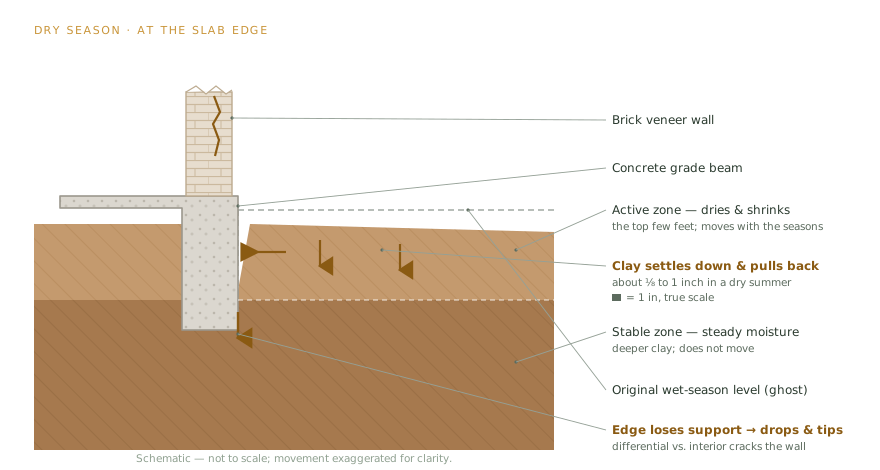
Weeks of heat and no rain pull moisture out of the soil. It contracts and pulls away from your slab, leaving gaps underneath.
The clay swells
A downpour swells the soil back up — but unevenly, faster on some sides than others. Every swing flexes the slab.
The slab cracks
That repeated, uneven movement is what cracks foundations, sticks doors, and splits drywall.
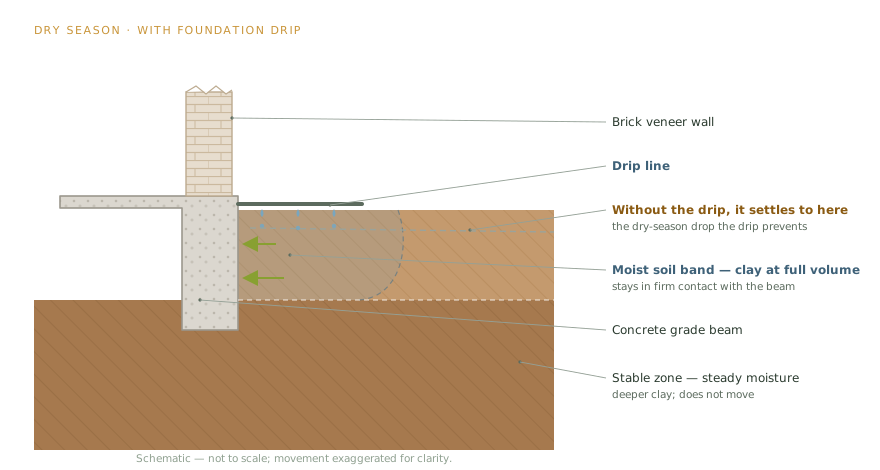
Keep the soil around the foundation at a steady moisture level and the swings stop. That's all a foundation drip system does — and it's why it works so well on Haltom City's clay. The full science is in the complete foundation drip guide.
Your Foundation Can Run
Any Day.
This is the part most homeowners get wrong, and it matters: Haltom City's twice-a-week limit is for sprinklers. Your foundation is treated differently.
Sprinklers are limited. Foundation drip isn't.
Haltom City runs the permanent, year-round twice-a-week watering schedule used across the Mid-Cities. In-ground sprinklers are held to two days a week and may not run in the heat of the day. But drip, soaker, and hand watering for your foundation are handled separately — they can be done any day. That's exactly why a dedicated foundation zone is the right tool: it keeps your slab's soil steady on the schedule your foundation needs, without touching your sprinkler days.
Haltom City has the most varied housing in the area, and water pressure swings more here than anywhere — one neighborhood might run 85 PSI and the next 45. That matters for a foundation system: a cheap setup waters unevenly when pressure varies, but the pressure regulator and pressure-compensating drip line I install keep the water even whether your street runs high or low. It's exactly the kind of local detail that separates a system that works from one that quietly doesn't. Many of Haltom City's oldest slabs have also never had any watering — and those are often the homes that benefit most.
What Haltom City homeowners should know.
Where Haltom City foundations move most
Haltom City is one of the older inner-ring suburbs north of Fort Worth, and a lot of its housing stock has been on the same expansive clay since the postwar years. The established neighborhoods off Belknap, Broadway, and Denton Highway are full of slabs that have flexed through fifty-plus summers. Older homes that have never had their soil moisture managed are the ones most likely to show movement — and they’re also the ones where catching it early saves the most.
Watering your foundation through the year
Summer is when the damage happens. Weeks of Haltom City heat with no rain dry the clay until it contracts and pulls away from the slab edges, and that’s when an older foundation starts to talk — sticking doors, fresh cracks. Running a foundation drip zone steadily from June through September keeps the soil from drying out that hard. In spring and fall it needs little, and after a good rain, nothing. Steady is the whole idea — not wet, just never bone-dry.
Signs your Haltom City slab is moving
In an older Haltom City home the signs tend to show up at the weak points first: a door that won’t latch by late summer, cracks creeping up from a doorway corner, stair-step separations in the exterior brick, or daylight opening between the slab and the soil. One or two after a dry stretch is the clay moving. On a home this age, catching it before it needs piers is the difference between a small ongoing cost and a big one-time bill. The deeper how-and-why is in the complete foundation guide.
You Get Landon.
Every Time.
Haltom City is about fifteen minutes southwest of my NRH base — close enough that you get the same licensed irrigator every visit, not a rotating franchise crew.
A crew from somewhere else
- A rotating crew you've never met, dispatched from across DFW
- Priced to feed a sales team and an office — and to upsell the whole house
- Here today, hard to reach when you have a question next season
- Generic schedule that doesn't account for your specific Haltom City soil
The licensed irrigator who answers the phone
- Based in nearby North Richland Hills — Landon does the assessment and the install himself
- $0 service call, and only the sides that need coverage get scoped — no default upsell
- The same person every time, who knows your system because he built it
- Programmed for the local expansive clay and Haltom City's watering rules, firsthand
- Licensed Texas irrigator (TCEQ LI0031476) — the work is done to code and built to last
The Short Version
for Haltom City Homes.
It starts free, and it starts honest. The full process, components, and cost breakdown live on the installation page — here's the shape of it.
A free on-site look at your soil and which sides need coverage, an honest recommendation (including "you don't need one" when that's true), then a dedicated drip zone — its own valve, an inline filter, a pressure regulator, and pressure-compensating line set about a foot out from the slab — programmed for your soil and the local rules, with a walk-through and a yearly check. See the full breakdown and honest cost drivers on the foundation drip installation page.
Yes. Haltom City follows the regional year-round twice-a-week schedule, but that limit is for in-ground sprinklers. Drip, soaker, and hand watering for a foundation are treated separately and may be done any day — so a dedicated foundation zone runs on the schedule your slab needs. Check your exact sprinkler days and the official source on the watering-restrictions page.
Haltom City sits on the same expansive clay as the rest of the Mid-Cities — a high-shrink-swell soil that expands when wet and contracts hard when it dries in summer. As the soil pulls away from the slab and the moisture underneath gets uneven, the slab moves, and that movement cracks foundations. Keeping the perimeter soil steady prevents it — exactly what a foundation drip system does.
Spray Irrigation Co. is based in North Richland Hills, about 15 minutes from Haltom City, and owner-operated by Landon Melvin. You get the same licensed irrigator who answers the phone showing up to do the work — not a rotating crew from a franchise across the metroplex. I know the local clay and the regional watering rules firsthand.
For a permanent irrigation system tied into your water supply, yes — Texas requires it be done by an irrigator licensed through the TCEQ. Spray Irrigation Co. is licensed (LI0031476). A DIY soaker hose on a garden spigot is a different matter, but a proper installed foundation zone with a dedicated valve should be done by a licensed irrigator — for code and for a system that lasts.
Installs start at $1,500, and the final price depends on the home, so the assessment is free and there's no service call fee. The main drivers are how many sides need coverage, the linear footage of drip line, and whether it ties into an existing controller. I quote it straight after seeing your house — and if your home doesn't need a system, I'll tell you. The full breakdown is on the installation page.
Start with the free assessment — there's no service call fee, so it costs you nothing to find out where you stand. On an older Haltom City home that's never had watering, the foundation is often the single highest-value place to start, ahead of a full lawn system. I'll check your soil, your drainage, and which sides actually need coverage, then tell you straight whether a foundation zone is worth it. Because pressure varies so much here, I always check your static pressure before quoting, so the system is sized right for your specific street.
Before the summer heat dries the clay out, not after. In Haltom City the soil starts shrinking away from slabs through June to September, so a foundation zone should be running by early summer. On an older home that's already been through decades of cycles, getting ahead of the dry-down matters even more.
No — it's prevention, not repair. A foundation zone keeps the soil moisture steady so the slab stops moving, which protects against new and worsening damage. Existing cracks are a job for a foundation repair company. But once a slab is repaired or piered, steady soil moisture is exactly how you keep it from happening again — the cheapest part of the whole equation.
Let a Local Irrigator
Take a Look.
No trip fee. No pressure. No contract. I'll come out to your Haltom City home, check your soil and drainage, and tell you honestly whether a foundation system is worth it — and quote it straight if it is.